公司注册类型的选择
1.1
对于外商投资者的限制
根据乌兹别克斯坦《投资与投资活动法》的相关规定,乌兹别克斯坦对外商投资者的设立类型并未作出强制性规定,外商投资者可以根据自身条件设立不同公司:外商投资企业可以在乌兹别克斯坦共和国境内设立具有法人资格的子公司、分支机构、代表处和其他不具有法人资格的独立机构。
并且,外商投资企业可以在自愿的基础上,在乌兹别克斯坦共和国境内成立协会和其他商业协会,也可以作为正式会员加入现有的商业协会。
同时,乌兹别克斯坦政府对外资投资企业是否需要本地股东、董事并未作出强制性要求。即,外商投资者可以在乌兹别克斯坦设立100%外资股权的外商投资企业。
对于特定行业的外商投资者所持有股权比例的要求,具体如下:
1. 能源行业。诸如能源及重点矿产品(如铀)开发等领域有股权限制,外资所占股份一般不超过50%;铁路等领域则完全由国家垄断。乌兹别克斯坦在近年来逐步减少外商投资对能源行业的限制。截止2024年,电力、石油天然气领域上游发电和油气开采对外资开放;国家输电网、国内天然气输气管网由乌国有企业垄断,不对外资开放。乌计划逐步消除能源、石油和天然气、水务、道路建设、铁路和机场服务等多个领域的17种国家垄断。(出自商务部对外投资和经济合作司、商务部国际贸易经济合作研究院、中国驻乌兹别克斯坦大使馆经济商务处对外投资合作国别(地区)指南乌兹别克斯坦2024年版)
2. 传媒行业。根据《大众传媒法》(https://lex.uz/docs/1106875)第八条之规定,外资企业允许在乌开办报纸、杂志、新闻社、电视台、电台、网站等,但不得以独资企业形式存在,传媒领域合资企业外资占比不得超过30%。
3. 金融行业。根据《关于私人银行和金融机构及其活动担保的法律》第三条第一款之规定:“私人银行和金融机构是指银行和其他信贷组织、保险组织以及其他专门提供金融服务的法人实体,其注册资本(授权基金)中个人(创始人(参与者)的份额必须至少占百分之五十。”若外商投资者在乌投资、设立私人银行或是金融机构,需满足该自然人股权比例要求。

图片来源于豆包AI
1.2
不同公司类型的比较分析
外国投资在乌境内可以各种形式实现,包括:与乌法人或自然人共同设立的经营公司、合伙公司、银行、保险机构及其他企业,并持有法定资本;设立并发展外国投资者全资经营公司、合伙公司、银行、保险机构及其他企业。
乌兹别克斯坦常见的企业形式有:
1
有限责任公司(LLC)
2
股份公司(JSC)
3
合伙企业(Partnerships),包括完全合伙、有限合伙
4
生产合作社(Production Cooperative)
5
外国公司分支机构(Branch)与代表处(Representative Office)
6
国有企业或国有控股企业的合资(Joint Venture with SOE)
各类型企业间的区别见下表:
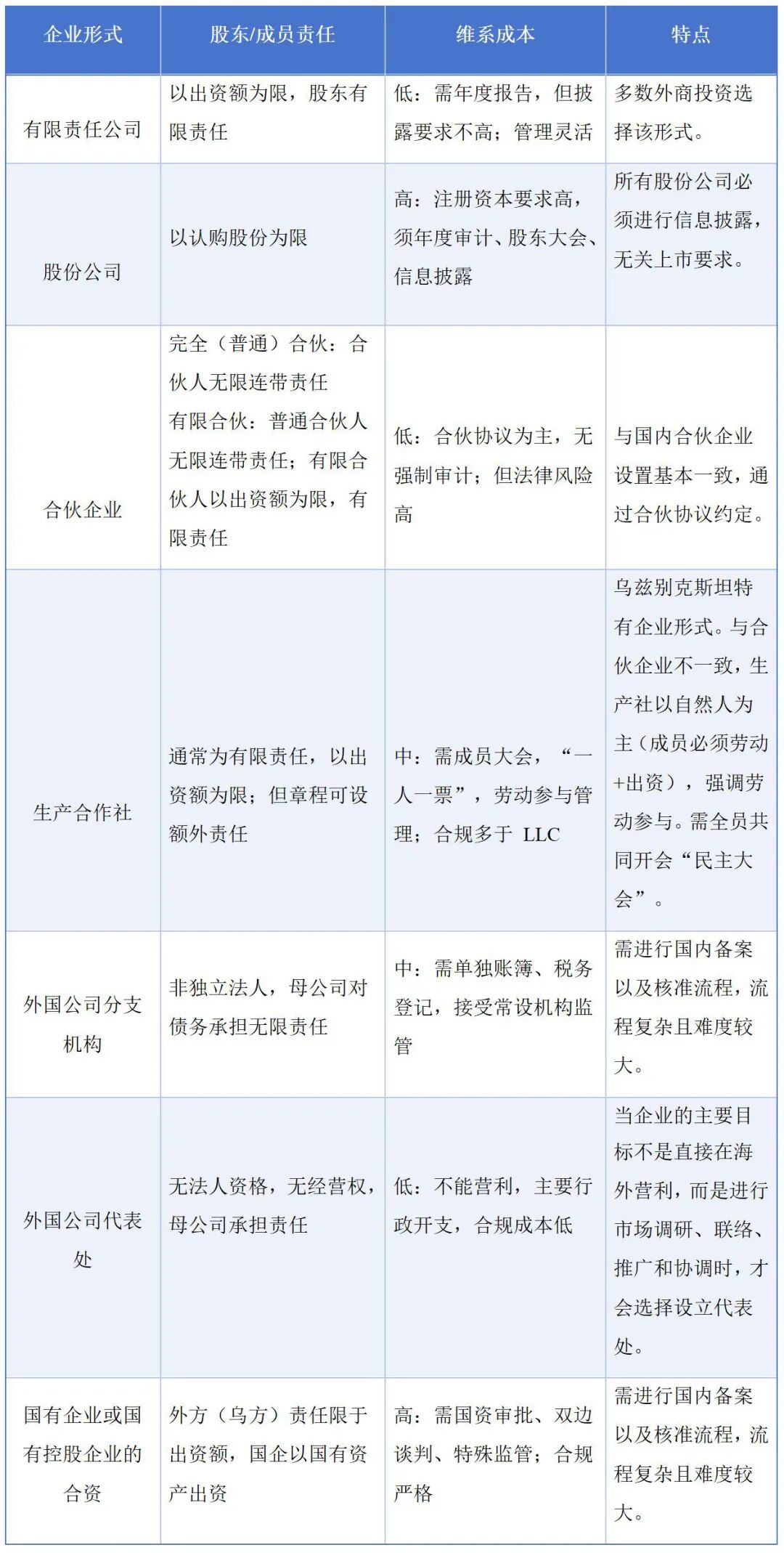
税收方面:《乌兹别克斯坦税法典》(https://www.lex.uz/ru/docs/4674893,以下简称“《税法典》”)对企业类型进行了定义:以下企业被视为乌兹别克斯坦的税收居民企业:(1)在乌兹别克斯坦注册并成立的企业;(2)根据适用税收协定被认定为乌兹别克斯坦税收居民的外国企业;(3)实际管理机构所在地在乌兹别克斯坦的外国企业,税收协定另有规定的除外。因此,外商投资并在乌兹别克斯坦设立企业(不论类型),该设立企业被视为居民企业,需承担对应扣缴义务。
《税法典》对居民企业的企业所得税进行了规定:企业所得税一般税率为15%,特殊类别税率将调整:商业银行、生产聚乙烯颗粒的公司以及提供移动通信服务的公司的税率为20%;市场和商业综合体服务收入的税率为20%;从事商品(工程、服务)电子商务的纳税人适用的税率为7.5%(条件是电子商务收入占年收入90%以上)。居民企业之间的股息征收5%的预提税。因此,各类型企业之间的企业所得税基本一致,不同企业是根据所从事行业的不同缴纳各自的企业所得税。并且,《税法典》特别规定,从2021年9月14日起,费尔干纳州的某些地区被选定为具有特殊税制的地区,这些地区的企业所得税的税率为1%。同时,根据《税法典》第二十一条之规定,若外国投资者在企业注册资本中份额大于33%,股份公司中份额超过15%,则该法人实体可享受免征土地税、财产税和水使用税形式的税收优惠。
乌兹别克斯坦《外国投资法》(现为《投资与投资活动法》)还规定,若外国企业注册后,《税法典》引入了对企业不利的新规定,则该规定在企业注册后的5年内将不适用于该企业。此外,如果外国投资者以现金形式出资不少于500万美元,那么该企业在注册后的10年内将免受《税法典》中新增的对企业不利的企业所得税、增值税、财产税、社会税和营业税的影响。
目前,在乌兹别克斯坦的投资实践中,外资最常选择的企业组织形式是有限责任公司(LLC)和股份公司(JSC)。其主要原因在于:首先,有限责任公司设立流程简便、成本较低,股东仅以出资额为限承担责任,既有利于控制法律风险,又便于灵活进入市场;其次,股份公司虽然维系成本较高,但因其资本规模大、治理结构较规范,更适合能源、矿产、金融等战略性或大规模项目,符合现代背景下中国前往投资的背景。相比之下,合伙企业因完全合伙人需承担无限责任、风险过高,生产合作社则更强调成员劳动参与,均不符合外资追求资本回报的偏好;而代表处和分支机构仅适合市场调研或过渡阶段,并不常用于长期投资经营。因此,外资在权衡股东责任的可控性、合规维系成本以及设立效率后,往往倾向于以有限责任公司作为进入市场的常用工具,在特定行业则通过与国有企业的合资来开展业务。
根据2018年8月1日发布的第UP-5495号总统令,外商投资者在乌设立有限责任公司(含中乌合资公司及100%外资公司)时,需同时满足两项核心条件:一是外资持股比例不低于15%;二是注册资本最低限额为4亿乌兹别克斯坦苏姆(UZS),按当前汇率折算约合人民币22.68万元。此外,外商投资者在乌设立股份公司同样需符合最低注册资本要求,标准与有限责任公司一致,即最低4亿乌兹别克斯坦苏姆(UZS,约合人民币22.68万元)。需特别说明的是,该股份公司注册资本要求为统一适用标准,无论企业是否含外资成分,均需严格遵守。
在绝大多数情况下,中资企业在乌投资均以设立有限责任公司的形式开展工作,如中石油中亚天然气管道有限公司、华为技术投资塔什干有限责任公司等。有限责任公司的设立、出资、股东权利、公司治理、解散清算等法律制度主要由乌兹别克斯坦《有限责任公司和补充责任公司法》(https://lex.uz/ru/docs/18793)规定,其基本制度与大陆法国家公司法较为相近。乌兹别克斯坦有限责任公司实行股东会、董事会、公司高级管理人员三级公司治理机制,公司经理是乌兹别克斯坦有限责任公司的法定代表人。

图片来源于豆包AI
1.3
有限公司的注册流程
根据2016年颁布实施的2642号法令《关于完善企业主体国家注册登记系统》(https://lex.uz/ru/docs/3063483)、2017年2月第66号政府决议、(https://lex.uz/ru/docs/3111342)、2020年12月的763号政府决议(https://lex.uz/ru/docs/5136767)有限公司的注册流程如下:
1
准备公司章程和发起人协议、委托授权书等注册文件(乌兹别克语文本,其余材料可俄文);
2
委托授权书等注册文件;
3
国家服务中心进行注册;
4
取得营业执照后刻制公章;
5
取得公章后去银行开设对公账户,并经对公账户支付税务钥匙登记费用;
6
在注册地址所在区的税务局进行税务登记;
7
税务登记后携带优盘返回国家服务中心拷贝专属的电子税务账号及密码。
特别注意:若股东为外国法人,需要以该法人名义出具注册公司的授权委托书,以及该法人关于在乌设立公司的内部股东决议。以上文件应为中俄或中乌双语,并需在该法人所在国进行公证认证,注册时应提供原件以及受托人的护照和纳税号。
若股东为自然人,应提供该自然人的护照和纳税号,注册时本人应在场或出具授权委托书全权委托他人办理,授权委托书需根据要求办理公证认证手续。
公司设立文件,即公司章程、发起人协议,应使用乌兹别克语。章程中应明确公司的名称、经营范围、注册资本金、注册地址、内部管理及其他事项等。拟设立公司的名称可以提前通过https://fo.birdarcha.uz/pub/booking进行查重并锁定。
根据《乌兹别克斯坦共和国有限责任和补充责任公司法》(https://lex.uz/ru/docs/18793)规定,股东应在公司注册之日起的一年内实缴注册资本金。
在资料准备齐全情况下,在乌注册一家公司大约需要3至5个工作日。

图片来源于豆包AI
Uzbekistan Investment Guide: Corporate Structures
Choice of Company Registration Types
1.1
Restrictions on Foreign Investors
According to the provisions of the Law on Investments and Investment Activities of Uzbekistan, there are no mandatory requirements regarding the form of establishment for foreign investors. Foreign-invested enterprises may establish subsidiaries with legal personality, as well as branches, representative offices, and other independent entities without legal personality within the territory of the Republic of Uzbekistan.
Foreign-invested enterprises may also, on a voluntary basis, establish associations and other business unions in Uzbekistan, or join existing business associations as full members.
At the same time, the Uzbek government does not impose mandatory requirements on whether foreign-invested enterprises must have local shareholders or directors. In other words, foreign investors are permitted to establish wholly foreign-owned enterprises in Uzbekistan.
For certain industries, there are specific requirements regarding the equity ratio held by foreign investors, as follows:
1. Energy sector. In areas such as energy and the development of key mineral resources (e.g., uranium), foreign ownership is generally restricted to no more than 50%, while sectors such as railways remain entirely under state monopoly. In recent years, Uzbekistan has gradually reduced restrictions on foreign investment in the energy industry. As of 2024, the upstream segments of electricity generation and oil and gas exploration have been opened to foreign investors, while the national power transmission grid and domestic natural gas pipeline network remain monopolized by state-owned enterprises and are not open to foreign investment. Uzbekistan has announced plans to gradually eliminate 17 categories of state monopolies in sectors including energy, oil and gas, water supply, road construction, railways, and airport services. (Source: Country (Regional) Guide for Outbound Investment and Cooperation: Uzbekistan 2024, issued by the Department of Outward Investment and Economic Cooperation of MOFCOM, the Chinese Academy of International Trade and Economic Cooperation, and the Economic and Commercial Section of the Embassy of the PRC in Uzbekistan.)
2. Media sector. According to Article 8 of the Law on Mass Media (link), foreign enterprises are allowed to establish newspapers, magazines, news agencies, television stations, radio stations, websites, and other media outlets in Uzbekistan. However, wholly foreign-owned enterprises are not permitted in this sector, and in media joint ventures, foreign ownership may not exceed 30%.
3. Financial sector. According to Article 3, Part 1 of the Law on Private Banks and Financial Institutions and the Guarantees of Their Activities, “Private banks and financial institutions refer to banks and other credit organizations, insurance organizations, and other legal entities that specialize in providing financial services, in which the share of individuals (founders/participants) in the charter capital (authorized fund) must be at least 50%.” Therefore, if foreign investors establish or invest in private banks or financial institutions in Uzbekistan, they must meet this requirement regarding the proportion of natural-person shareholding.
1.2
Comparative Analysis of Different
Company Types
Foreign investment in Uzbekistan can take various forms, including: establishing joint operating companies, partnerships, banks, insurance institutions, and other enterprises together with Uzbek legal entities or individuals, and holding statutory capital; or establishing and developing wholly foreign-owned operating companies, partnerships, banks, insurance institutions, and other enterprises.
The most common forms of enterprises in Uzbekistan are:
1
Limited Liability Company (LLC)
2
Joint Stock Company (JSC)
3
Partnerships, including general partnerships and limited partnerships
4
Production Cooperative
5
Branches and Representative Offices of foreign companies
6
Joint Ventures with State-Owned Enterprises (SOEs) or state-controlled enterprises.
The distinctions among these types of enterprises are summarized in the following table:
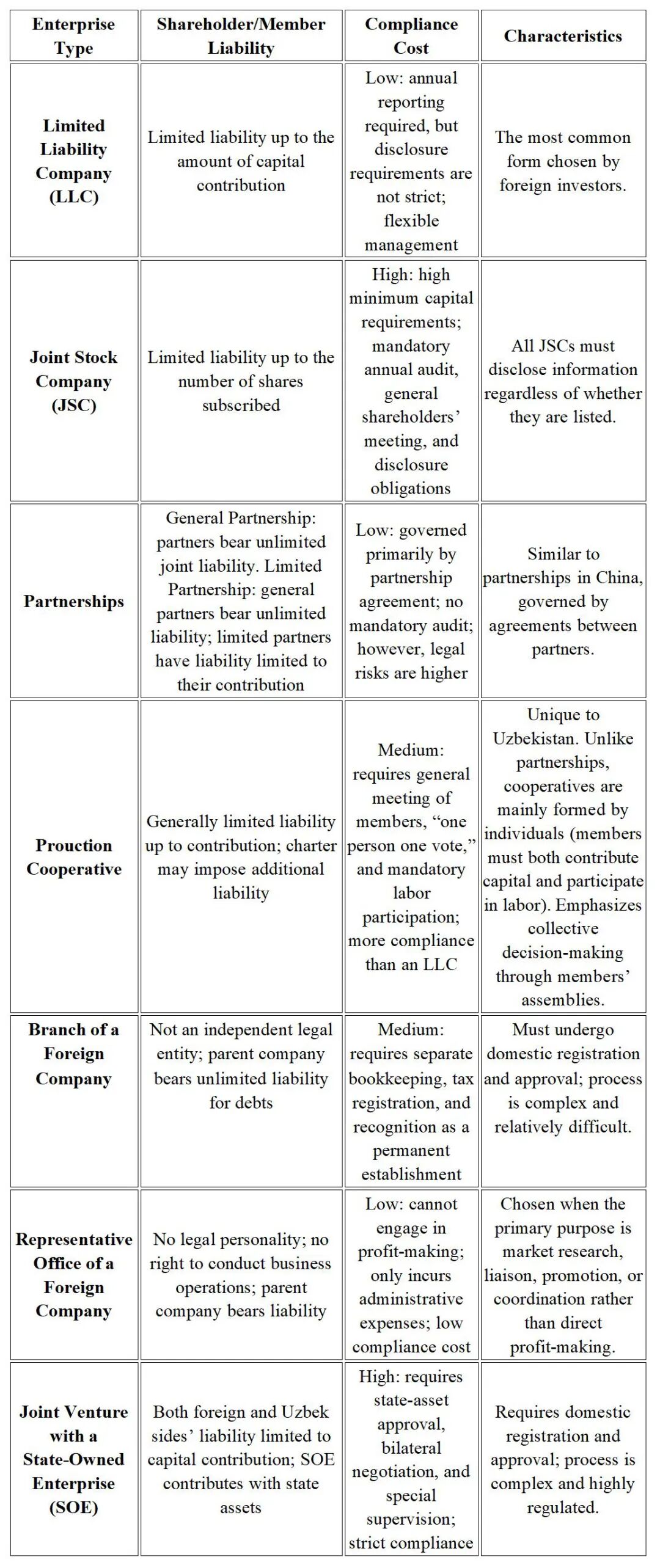
In terms of taxation, the Tax Code of Uzbekistan (https://www.lex.uz/ru/docs/4674893, hereinafter the “Tax Code”) provides definitions of corporate types: the following entities are considered tax resident enterprises of Uzbekistan: (1) enterprises incorporated and registered in Uzbekistan; (2) foreign enterprises deemed Uzbek tax residents under applicable tax treaties; and (3) foreign enterprises whose place of effective management is located in Uzbekistan, unless otherwise stipulated by tax treaties. Accordingly, foreign investors that establish an enterprise in Uzbekistan (regardless of the corporate form) will be deemed resident enterprises and will be subject to the corresponding withholding obligations.
The Tax Code prescribes that the standard corporate income tax (CIT) rate for resident enterprises is 15%, while special categories are subject to adjusted rates: 20% for commercial banks, companies producing polyethylene granules, and providers of mobile communication services; 20% for income derived from markets and commercial complexes; and 7.5% for taxpayers engaged in e-commerce of goods (works, services), provided that e-commerce revenue accounts for at least 90% of annual income. Dividends distributed between resident enterprises are subject to a 5% withholding tax. Thus, the CIT regime is largely uniform across different corporate forms, with the applicable tax rate determined primarily by sector of activity.
Furthermore, the Tax Code expressly provides that, as of 14 September 2021, certain areas in the Fergana region have been designated as special tax zones where enterprises may benefit from a reduced CIT rate of 1%. In addition, under Article 21 of the Tax Code, if a foreign investor holds more than 33% of the charter capital of a company, or more than 15% in a joint stock company, the legal entity may qualify for exemptions from land tax, property tax, and water use tax.
The Law on Foreign Investments of Uzbekistan (now the Law on Investments and Investment Activities) further provides that if, after the registration of a foreign enterprise, new provisions of the Tax Code unfavorable to enterprises are introduced, such provisions shall not apply to that enterprise for a period of five years from the date of its registration. Moreover, if a foreign investor contributes at least USD 5 million in cash, the enterprise will, for ten years from the date of its registration, be exempt from the impact of any newly introduced unfavorable provisions of the Tax Code relating to corporate income tax, value-added tax, property tax, social tax, and turnover tax.
In current investment practice in Uzbekistan, the corporate forms most commonly chosen by foreign investors are limited liability companies (LLCs) and joint stock companies (JSCs). The main reasons are as follows: first, LLCs are relatively simple to establish and maintain, involve lower costs, and limit shareholder liability to the amount of their contributions, thereby reducing legal risk while enabling flexible market entry. Second, although JSCs are more costly to maintain, they typically involve larger capital, more formalized governance structures, and are thus better suited for strategic or large-scale projects in sectors such as energy, mining, and finance, which aligns with the context of Chinese outbound investment. By contrast, partnerships—where general partners bear unlimited liability—entail excessively high risk, while production cooperatives emphasize members’ labor participation and are therefore ill-suited to the capital-return focus of foreign investment. Representative offices and branches are primarily used for market research or transitional presence rather than long-term business operations. Consequently, when weighing shareholder liability, compliance costs, and establishment efficiency, foreign investors generally favor LLCs as the most common vehicle for market entry, while in certain industries they engage in joint ventures with state-owned enterprises.
According to Presidential Decree No. UP-5495 of 1 August 2018, foreign investors establishing an LLC in Uzbekistan (whether a Sino-Uzbek joint venture or a wholly foreign-owned company) must meet two core conditions: (i) the foreign equity share must not be less than 15%; and (ii) the minimum charter capital must be UZS 400 million (approximately RMB 226,800 at the current exchange rate). Similarly, foreign investors establishing a JSC must comply with the same minimum charter capital requirement of UZS 400 million (approximately RMB 226,800). It should be noted that this minimum charter capital requirement applies uniformly to all JSCs, regardless of whether foreign investment is involved, and must be strictly observed.
In the vast majority of cases, Chinese enterprises invest in Uzbekistan by establishing limited liability companies (LLCs), such as China National Petroleum Corporation Central Asia Gas Pipeline Co., Ltd. and Huawei Technologies Investment Tashkent LLC. The legal framework governing the establishment, capital contribution, shareholder rights, corporate governance, dissolution, and liquidation of LLCs is primarily set out in the Law of the Republic of Uzbekistan on Limited and Additional Liability Companies (https://lex.uz/ru/docs/18793). Its fundamental structure is broadly consistent with corporate laws in continental civil law jurisdictions.
An Uzbek LLC adopts a three-tier governance structure comprising the general meeting of shareholders, the board of directors, and senior management. The company manager serves as the legal representative of the LLC in Uzbekistan.
1.3
Registration Procedure for Limited Liability Companies
According to Presidential Decree No. 2642 of 2016 On Improving the State Registration System of Business Entities (https://lex.uz/ru/docs/3063483), Government Resolution No. 66 of February 2017 (https://lex.uz/ru/docs/3111342), and Government Resolution No. 763 of December 2020 (https://lex.uz/ru/docs/5136767), the registration procedure for limited liability companies (LLCs) in Uzbekistan is as follows:
1
Preparation of registration documents, including the company charter, founders’ agreement, and power of attorney (documents must be in Uzbek; other materials may be in Russian).
2
Submission of powers of attorney and other registration documents.
3
Registration through the National Service Center.
4
Upon obtaining the business license, production of the company seal.
5
After obtaining the seal, opening of a corporate bank account and payment of the tax key registration fee through the account.
6
Tax registration with the district tax authority at the place of the company’s registered address.
7
After completing tax registration, returning to the National Service Center with a USB drive to obtain a copy of the exclusive electronic tax account and password.
Special Note:
If a shareholder is a foreign legal entity, it must issue a power of attorney in the name of the legal entity for the purpose of registering the company, as well as an internal shareholders’ resolution authorizing the establishment of the company in Uzbekistan. These documents must be bilingual (Chinese–Russian or Chinese–Uzbek), notarized and legalized in the country of the legal entity’s incorporation, and submitted in original form together with the authorized representative’s passport and tax identification number.
If a shareholder is a natural person, he or she must provide a passport and tax identification number. The individual must either be present during registration or issue a notarized and legalized power of attorney authorizing another person to act on their behalf.
The company’s founding documents, i.e., the charter and the founders’ agreement, must be drafted in Uzbek. The charter must clearly state the company’s name, business scope, charter capital, registered address, internal governance, and other relevant matters. A proposed company name can be checked and reserved in advance via https://fo.birdarcha.uz/pub/booking.
Under the Law of the Republic of Uzbekistan on Limited and Additional Liability Companies (https://lex.uz/ru/docs/18793), shareholders must fully pay in the charter capital within one year from the date of the company’s registration.
Provided all documents are in order, company registration in Uzbekistan typically takes approximately 3 to 5 business days.
律师简介
喻冰清律师
简介
• 维思德律师事务所涉外法律事务部部长
• 湖北省律协涉外领军人才律师
• 中国及美国纽约州执业律师
• 工业和信息化部认证数据安全师
经验
• 喻冰清专注于为企业出海提供一站式的法律服务。其对于企业出海北美、欧洲、东南亚、中东、日本等地具有丰富的法律实操经验,擅长互联网泛娱乐业、跨境电商、供应链仓储物流、医疗器械、建材、零部件、化妆品、服装、餐饮等多个行业的出海合规法律服务,为客户境内外战略发展、合规、争议纠纷等复杂法律问题提供切实可行的解决方案。

毛迈律师
简介
• 维思德(深圳)律师事务所律师
• 北京大学 文学学士学位
经验
• 后赴美国纽约深造,经三年学习,获法律博士学位(J.D.),通过美国纽约州法律职业资格考试。在美期间专修公司法、商法、证券法、破产法、信托法,并能熟练运用美国法律数据库进行法律研究。学习期间在北京某顶级律师事务所实习。回国后顺利通过国家法律职业资格考试。
梁思瑾律师
简介
• 维思德(深圳)律师事务所律师
• 伦敦国王学院,获国际商法法学硕士学位
经验
• 在伦敦求学期间,主要研习课程包括企业融资的法律问题、企业并购与收购、公司治理等核心领域。具备扎实的法律专业功底与出色的英语应用能力,能够熟练处理公司法领域各类法律事务、提供专业企业法律顾问服务,并可高效应对与公司法、日常经营相关的涉外法律问题。
• 主要业务领域涵盖:民商事争议解决、公司法、涉外法律服务等。
撰稿|毛 迈
梁思瑾
协作|喻冰清
校对|喻冰清
李 丹
排版|刘晨卉
审核|丁 静
冯颖琼
招贤纳士
JOIN US
未来合伙人 /WISDOM
加盟要求
(1)具有3年以上律师独立执业经历;
(2)有稳定的案源,业务领域发展成熟,能够独立组建专业部门或业务团队;
(3)具有高度的职业道德和诚信,遵守律师职业行为准则;
(4)具有开拓精神及创新意识,较强的团队合作意识;
(5)认同律所文化和发展理念,能推动律所发展和品牌建设。
律师助理 /WISDOM
任职要求
(1)法学专业本科及以上学历、国内知名法学院校毕业者优先。
(2)通过国家司法考试,取得法律资格证A证。
(3)具有较强的写作能力、学习能力、表达能力、沟通能力和团队协作能力。
(4)品行端正,责任心强,有志于长期从事律师职业。
岗位职责
(1)参加法院庭审、非诉调查、项目跟进等律师实务工作;
(2)协助律师做好客户接待工作,进行有效沟通;
(3)在律师指导下协助起草文件,进行案卷整理归档工作;
(4)协助律师进行法律条文和案例检索,法律调查和研究。

@
联系我们
简历请投递至人资邮箱:wuhan@wsdlaw.cn